


While economic profile and political relevance define the BRICS – the cooperation agenda in the last 20 years has been effectively development focused and rightly so! India’s association with BRICS is eminently justified on this count and India has steered the group towards development orientation and people centricity in recent years. In times of multiple intersecting crises that are getting manifested more severely now, a strong group like the BRICS is going to be consequential and indispensable in addressing those. Collective leadership and commitment of members that are sources of solutions and capacity is going to reshape the priorities of the group, strengthen it and perhaps keep it relevant for itself and the Global South in the coming years. India’s Chairship of BRICS in 2026 gave India the opportunity to most strongly articulate this need and design the agenda in order to place people-centricity and humanity first approach not only as the grand vision but also the operational template of cooperation.
India’s engagement with BRICS is to be seen as a substantive and sustained commitment within the larger civilizational ethos of Vasudhaiva Kutumbakam – turned into a foreign policy principle in modern times that promotes in practice the idea of embracing the world without discrimination or prejudice for the welfare of humanity. This is reflected in the call for ‘humanity first’ approach in engaging with BRICS at a critical juncture as India carries the responsibility of nurturing the partnership in the year of its Chairship. For those who drive the process and have made this group a vibrant platform, now with new members and a global outreach a collective stance on development and welfare would stand as the hallmark of cooperation and leadership. Despite faultlines globally, this moment of BRICS engagement strengthens the conviction for meaningful dialogue acknowledging the fact that while nations have born out of civilizations, cross-border movement of people and resources have made the world a culturally and intellectually richer place. Here is the real essence of ‘people-centric’ partnership that India as so eloquently placed as the overarching agenda for the BRICS in 2026. The BRICS over the years have evolved around cooperation on sustainable development and need to address the profound existential risks confronting the humanity. BRICS is a solutions provider at scale which is in all practical terms the real relevance of the group beyond economic and political influence. The members of the group have a common interest and an urge to build together when challenges are new. This itself is a noble cause. Hence the theme of this year’s BRICS Chairship – “Building for Resilience, Innovation, Cooperation and Sustainability”.
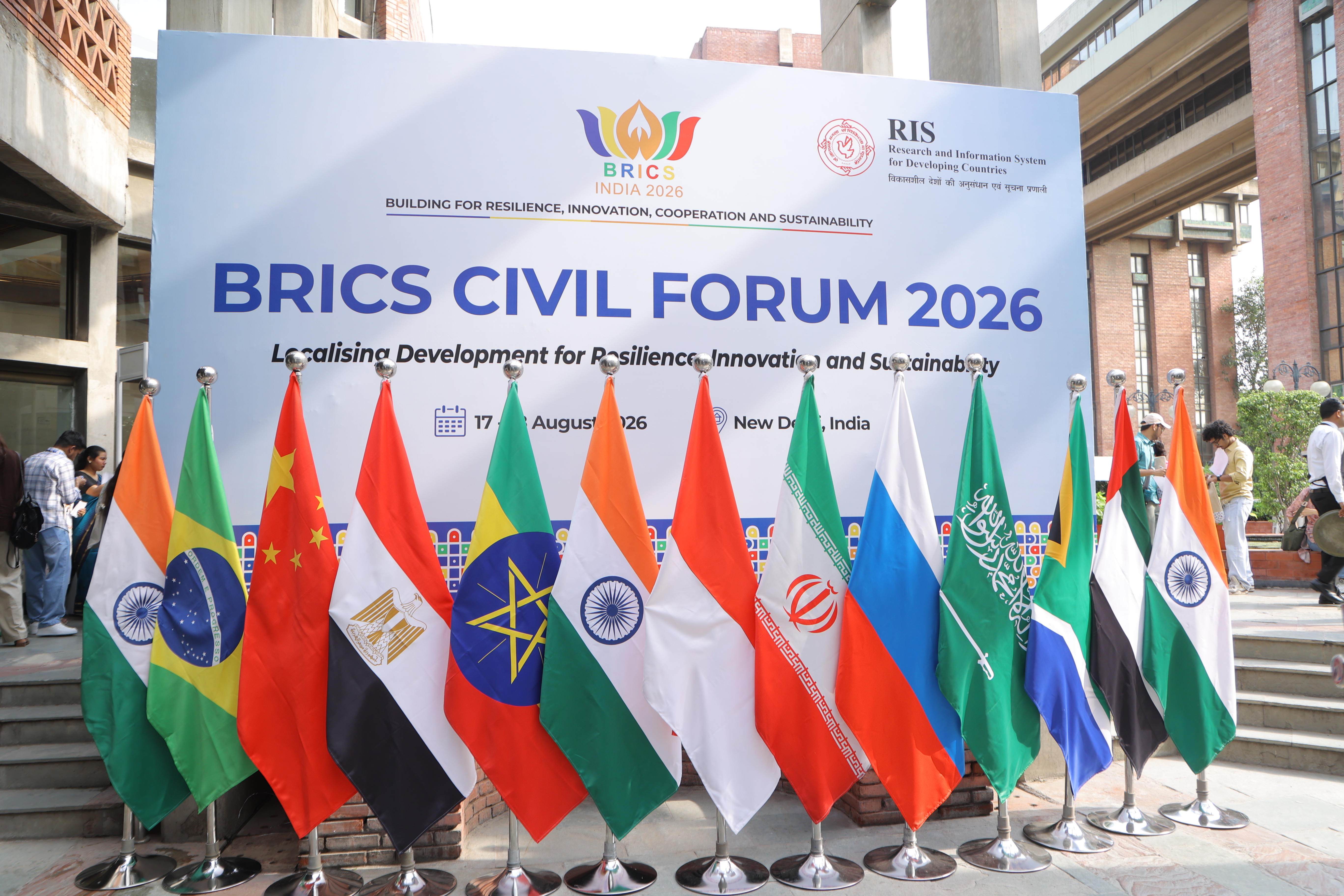
The bridge however, for a group of large emerging countries like the BRICS, which is mandated to cooperate with the aim of all-round development of member countries, would not be found in high-level interactions alone. It can only be achieved through elevating local experiences to global purpose and designing cooperation around it. As humanity faces existential risks, rootless solutions however sophisticated, have no meaning. For long, BRICS has treated Cultural and People-to-People Exchanges as a core mechanism of cooperation. However, stakeholder engagements in such areas can be leveraged more robustly through stronger partnership building efforts to bring Civil society across BRICS closer and make them relevant for knowledge sharing, policymaking and scaling up locally grounded solutions. The BRICS Civil Forum 2026, held in New Delhi recently under the theme “Localising Development for Resilience, Innovation and Sustainability” has been a milestone knowledge platform in this regard both in terms of scale and substance, as BRICS evolves and enters a new phase of expanding influence, and remains as mentioned earlier, the indispensable source of solutions for global challenges.
In the current context, international cooperation needs to become more responsive to local knowledge, local institutions and local development experiences. Yet there is a constant tension between global priorities, national policies and the varied local realities in which those policies are implemented. This suggests that the traditional top-down development model cannot make development more responsive towards institutions, knowledge and aspirations of local communities that are at the heart of resilience building in the face of multiple crises including climate change.
As BRICS Leaders would arrive in New Delhi, and guided by BRICS 2026 theme, would hopefully be deliberating more on new pathways of people-centric development for cementing cooperation for Resilience, Innovation, and Sustainability. India in the last one decade, has increasingly practiced this model of development and has emphasized on local resilience and self-reliance by no way undermining the importance of humanity first outreach globally. BRICS has featured very high on India’s agenda of global cooperation and is perhaps seen as the best platform to leverage national and local experiences for global solutions. This is reflected in India’s own efforts on SDG localisation and community enabled cooperative movements, focusing on district level enablers of development and resilience, and by connecting grassroots entrepreneurs and innovator with markets. India’s efforts have drawn global attention for its scale; innovative governance through empowering local drivers of change; achieving momentous success in financial inclusion for social safety, promoting grassroots entrepreneurship and livelihood with women at the core; and making technology a power of the people by ensuring universal access through nation-wide digital public infrastructure.
Development takes shape through the interaction of governments, citizens, people, firms, social institutions, and communities. However, access to resources has always remained a development challenge that needs to be solved collectively through innovative means as traditional market models often fail to reach the last mile. On the other hand, resilience building would suffer in the absence of partnership-based interventions with local relevance distinct from a narrow and often mechanically imposed, finance driven and techno-centric approaches on development. Economic development in the Global South, is manifested through rural economies, social enterprises, cooperatives, and local production systems that translate local capabilities into livelihoods that generate economic output. When the local actors gain access to finance, markets, technology, skills and institutions, they participate more effectively in larger economic systems. Local development, from this perspective, strengthens local agency to contribute to broader development.
Another aspect of local development is socially embedded in relationships, institutions through which communities participate. A local development model therefore needs to recognise the diversity of local needs, capabilities, institutions and aspirations in shaping their own development. Therefore, people-centred development can only take shape through localisation. Localisation is complementary to decentralisation, that ensures participation at the community level, focusing on locally rooted solutions, building climate and disaster resilience from the grassroots and reaffirming collective principles of development. The communities that are at the receiving end of development interventions need to be part of policy design; and not just passive agents. As one of the potential pathways, India’s BRICS Chairship has encouraged stronger participation of the civil society stakeholders on issues of social welfare and resilience building, promoting Jan Bhagidari, and thereby building on such experiences for consolidating cooperation in BRICS as well as in strengthening the effectiveness of BRICS initiatives. Finally, development interventions seek accountability, and BRICS may promote engagement of local actors for ensuring accountability and generating impact. Development must become a two-way exchange connecting local communities with global governance. This may become a continuing feature of BRICS as through such multidisciplinary and multi-stakeholder engagements, global commitments get redefined and purpose driven with strongly embedded bottom-up principles.
Disclaimer: The views expressed are those of the authors and do not represent that of the organisation.