


Visiting Fellow, RIS
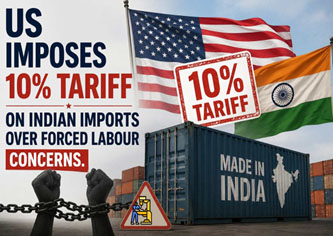
The United States under President Donald J. Trump has been experimenting with ‘reciprocal tariffs’ against its trading partners since April 2025. They had to be removed at times because the United States Supreme Court ruled against them, at times changed based on the Agreements on Reciprocal Tariffs (ARTs) signed with several US trading partners, and at other times imposed for a short period (like the 10 per cent tariffs for 150 days that end on 24 July 2026). The speed with which applicable tariffs changed over the last fifteen months gave no space for exporters to plan. On 23 July 2026, the United States Trade Representative has notified a fresh bout of additional tariffs on 60 countries which are likely to stay longer due to a better, even though questionable, legal basis in the US statute book, enabling traders to plan better.
For 19 countries that (a) impose a prohibition on the use of forced labour or (b) have a regime that has such an effect, and countries that (c) committed to impose such a prohibition through ART, the United States Trade Representative (USTR) has notified 10 percent tariff on import of non-exempted goods by making a determination after an investigation under Section 301 of the United States Trade Act, 1974 on such use of forced labour. India comes in category (b) above as it notified, as recently as 13 July 2026, a prohibition on import of goods produced using forced labour. These countries/economies include Argentina, Bangladesh, Cambodia, Canada, Ecuador, El Salvador, the European Union, Guatemala, Honduras, India, Indonesia, Jordan, Malaysia, Mexico, Pakistan, Sri Lanka, Taiwan, Trinidad & Tobago, and the United Kingdom.
This tariff will apply in addition to the normal Most-Favoured-Nation (MFN) tariff on those goods. For most goods exported by Canada and Mexico, the net tariff will be 10 per cent as they have a free trade agreement with the US. In the case of the European Union and Taiwan, on the other hand, the 10 per cent tariff will be net of MFN tariffs, giving them a similar advantage.
For the balance 41 countries, the Section 301 tariff has been kept at 12.5 per cent, applicable in addition to the MFN tariffs. The USTR has determined that this small 2.5 pe cent differential is significant enough to spur action against forced labour by these countries. It has also clarified that the investigation was broader than any supply chain related considerations, due to which the tariff will be applicable even to those goods which are produced under strict labour use guidelines and imported by the US retailers.
Several tariff-lines will be exempt from this across-the-board 10 per cent or 12.5 pe cent tariff as was the case in reciprocal tariffs and other similar tariff actions in the past 15 months, including the 10 per cent tariff imposed under Section 122 of the US Trade Act, 1984 based on the US balance of payments considerations. For example, pharmaceuticals and smartphones imported from India were exempt from such tariffs in the past and continue to be exempt. Based on economy-specific investigations and discussions, 471 tariff lines were added to the exemptions list. Based on pubic comments received on the preliminary determination made by the USTR in June 2026, it has been decided to exempt addition products from the Section 301 tariffs, including some animal products, animal hides and leather, seeds, vegetable products, sugars and sugar containing products, unflavoured instant coffee, fertiliser and pesticides inputs, wood products, pig iron, ferrous inputs and waste, aluminium scrap and waste, semiconductor manufacturing equipment etc.
In addition, additional exemptions were made for products from specific economies based on requested exemptions negotiated in the context of certain agreements and arrangements. Such negotiations included those with the members of the Dominican Republic – Central America – United States Free Trade Agreement, and the US-Jordan Free Trade Agreement.
Such negotiations were also held with those countries that had signed ARTs, like Jordan, Cambodia and Malaysia, and in cases where joint statements on Framework Agreements for negotiation of ARTs were announced like Argentina, Bangladesh, Ecuador, El Salvador, EU, Guatemala, India, Indonesia, North Macedonia, Thailand and Vietnam. Accordingly, there are two separate lists of exemptions; one which is applicable to all imports from the 60 countries and those applicable to specific countries.
The USTR has also announced that for textile and apparel products, tariff-rate-quotas (TRQs) will soon be established for Bangladesh, Cambodia, Indonesia, and Malaysia. These TRQs will be initially applicable for a period of 3 years, during which textiles and apparel from these countries will enter the US free of the Section 301 tariffs.
In conclusion, a more long-term tariff arrangement has been put in place by the US based on the Section 301 investigations, giving a more durable US market access regime for traders to plan their exports. However, there is a general exemptions list and another list containing specific exemptions for specific countries. Hence, the long list of exemptions providing different treatment to those countries with whom the US has free trade agreements or ARTs, or those whom the US wishes to oblige with a special textile mechanism sets up an arduous homework for exporters.
There are other uncertainties too. For example, the general exemptions list includes a long list of 710 tariff lines at 8-digit level of the Harmonised Tariff Schedule of the United States (HTSUS) of generic pharmaceuticals. This gives predictable market access to the Indian generic pharmaceutical exporters. However, a recent announcement by President Trump may imperil this predictability. He announced on 20 July 2026 that effective 1 August 2026, generics will be imparted into the US at zero duty for two years, whereafter they will attract 100 per cent tariff (and 200 per cent a year later) if the pharmaceutical companies abroad do not establish plants and equipment in the US to re-shore manufacturing back to the US. There may be added homework like this for others too.